The SOS Sequence
House of LeavesThe SOS Sequence is the decisive emergency sequence in The Navidson Record: a hidden distress call from inside the house converts waiting, domestic alienation, and failed communication into a rescue mission. Its importance is doubled by form. The signal is not only heard within the house but reproduced in Will Navidson’s editing, so that the sequence’s structure becomes its own second SOS, a call issued by a filmmaker who understands that his response may arrive outside the time in which it could save anyone.
Causes and Background
The sequence develops out of an increasingly unbearable wait for Holloway Roberts, Jed Leeder, and Kirby “Wax” Hook. For seven days there is no sign of the team. The footage registers the delay as a breakdown in both family life and documentary cohesion: jump cuts become more frequent, people stop speaking to one another, and no shot contains more than one person. Tom Navidson sleeps on the couch, Billy Reston listens with growing concentration to meaningless radio static, and Karen Green watches from the foyer, smoking inside the house for the first time. Will Navidson paces through the living room, impatient and resentful at being denied the opportunity to enter the extraordinary space himself.
By the seventh night, Reston fears that the expedition has ended in disaster. In the early morning of the eighth day, the house supplies an answer. The radio remains only an incomprehensible buzz, but a faint knocking rises from somewhere inside the structure. Chad Navidson and Daisy Navidson detect it first; when they reach their parents’ bedroom, Karen Green is already awake, the light on, listening. The sound consists of three quick knocks, three slow knocks, and three more quick knocks, repeated over and over: the recognizable pattern of SOS.
The family searches both floors but cannot locate the source. The signal resonates through every room, refusing to identify a single wall, passage, or chamber as its origin. Tom Navidson finally presses his ear against the living-room wall and reports that the sound seems to come from inside it, at one point seeming to be directly on the other side. The distress call therefore produces knowledge and uncertainty at once: someone or something is asking for assistance, but the house provides no stable position from which assistance can begin.
The Rescue Decision
The signal reverses the sequence’s visual and emotional condition. The divided household is brought back into a single frame, and Will Navidson finally receives the opportunity for which he has been waiting. He immediately declares his intention to lead a rescue attempt. Karen Green objects that the police should be called and questions why the celebrated Will Navidson must personally go to the rescue. Her protest exposes the conflict between ordinary responsibility and Navidson’s lifelong compulsion to confront danger directly.
Navidson’s answer is practical as well as personal. Holloway’s team has been inside for almost eight days and has water for only six; it is three in the morning, and waiting for officials or an organized search party would consume time the expedition may no longer possess. He also connects the decision to Delial, saying that he waited too long with Delial and will not repeat that failure. The unexplained name stops Karen cold. She says nothing further, sits on the couch, and waits while Navidson organizes the equipment.
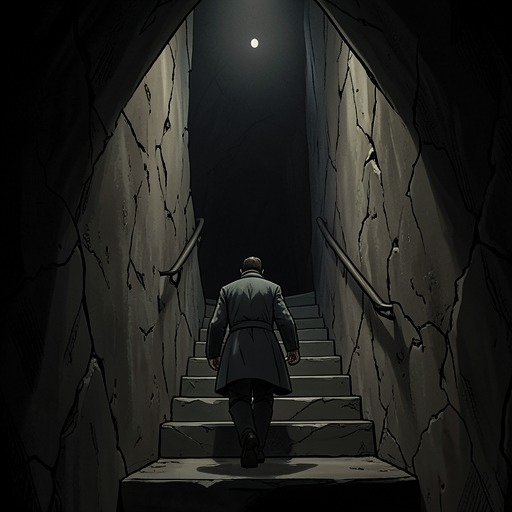
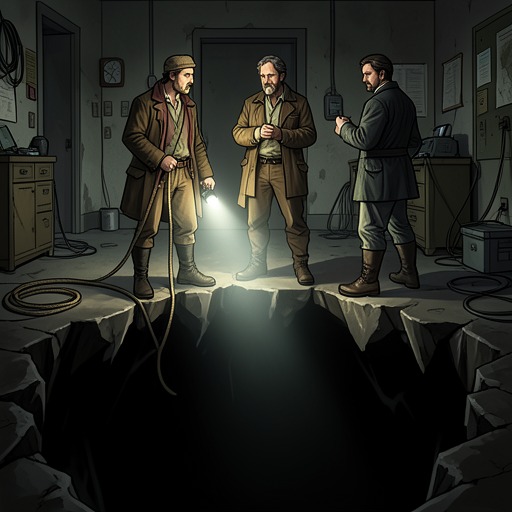
The preparations take thirty minutes. The intended plan is for Billy Reston to establish a camp at the stairway and operate the radios as a relay between the living-room command post and Will Navidson and Tom Navidson, who will descend farther into the hallway. Each participant wears a Hi 8 camera in a chest harness. Because two cameras are unavailable, Navidson removes one from the wall of his study and another from the upstairs hall. He also takes a 35mm Nikon with a powerful Metz strobe, while Reston volunteers to carry the 16mm Arriflex in his lap. Karen reluctantly assumes responsibility for the radios.
A Hi 8 camera records Karen watching the men disappear into the darkness. Three quick shots show her, with the final two occurring as she calls her mother to report Navidson’s departure and his reference to Delial. The phone is busy at first and then rings. The domestic telephone, like the radio and the knocking, becomes part of the sequence’s communication system: every channel carries delay, interruption, or a message whose meaning exceeds the household’s ability to control it.
Editing the Distress Signal
Will Navidson names the sequence SOS both because it represents the signal from Holloway’s team and because it encodes his own cry for help. While the footage depicts escalating tensions in the house, Navidson edits it according to a strict cadence. Tasha K. Wheelston identifies the pattern as an alternation between three shots of short duration and three shots of longer duration. Although the content occasionally interferes with the rhythm, the progression of three short, three long, and three short shots remains unmistakable.
The technique makes formal structure carry emotional pressure. The short shots accelerate perception, while the longer shots prolong the strain of waiting, listening, and watching people withdraw from one another. The visual rhythm translates the audible distress signal into editing, turning the sequence into a correspondence between the house’s message and the filmmaker’s state. The family’s impatience, frustration, and alienation are not merely subjects represented by the footage; they become the pulse by which the footage communicates.
The structure is also radically belated. Navidson shapes SOS long after the Holloway disaster has occurred and before his final plunge into the house. The sequence is consequently without simple hope: its appeal either arrives too late to save the missing team or is issued too early, before Navidson’s own final crisis has fully unfolded. The last two short shots of Karen on the telephone add an acoustic counterpart to the visual pattern: three busy signals followed by three rings. The film thus layers one emergency code over another, making failed contact itself the governing medium of the scene.
Consequences and Significance
The immediate consequence of SOS is action. The prolonged paralysis of the household ends, Will Navidson assumes command, and the rescue attempt begins with Tom Navidson accompanying him into the hallway while Billy Reston maintains the relay. The signal therefore changes the value at stake from frustrated curiosity to life and death. What had been an impossible architectural anomaly becomes an obligation, and Navidson’s desire to enter is recast as a duty to those who may still be alive.
The sequence also clarifies the documentary’s larger dependence on unstable media. The first appearance of the house had circulated informally as The Five and a Half Minute Hallway, a five-and-a-half-minute optical illusion whose claim to truth made it notorious. VHS copies passed from hand to hand without official distribution, degrading through successive dubs. Exploration #4 later appeared as an eight-minute, discontinuous fragment assembled from hurried, jarring edits. Against that history, SOS presents editing not as transparent preservation but as an active construction of meaning: the emergency is real within the story, yet its recurrence as a visual pattern is deliberately fashioned after the fact.
Navidson’s technical authority intensifies the effect. His personally shot footage is unusually steady, with controlled framing even in terrifying circumstances, unlike Holloway Roberts’s tilted, unfocused, badly lit tape or the less experienced recordings made by Karen Green and Tom Navidson. The extensive equipment gathered in the living room—monitors, decks, a VHS machine, computers, radio transmitters and receivers, cords, multiple cameras, flashlights, flares, rope, fishing line, extra batteries, tools, compasses, and a broken megaphone—makes the rescue appear methodical while also revealing how much technology is required merely to approach an environment that defeats ordinary orientation.
SOS ultimately binds story and discourse together. In chronological terms, a missing team sends a signal, the family hears it, Navidson organizes a rescue, and the men descend. In the film’s presented form, however, that emergency is reworked through rhythm, delay, repetition, telephone interference, and retrospective assembly. The sequence’s cry for help is therefore both an event and an artifact. Its most disturbing implication is that recognition does not guarantee timely intervention: the message can be heard, interpreted, and beautifully shaped only after the moment when understanding might have altered the outcome.